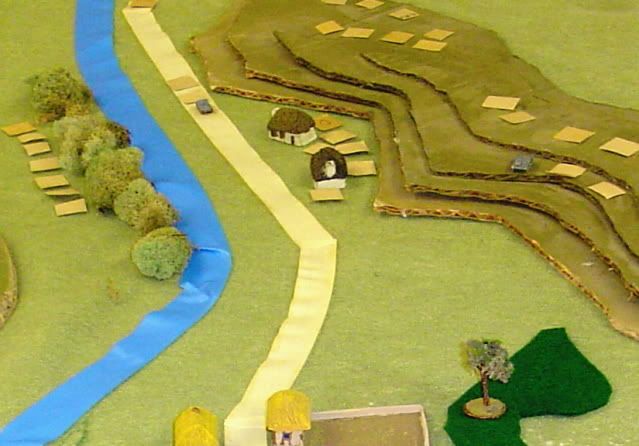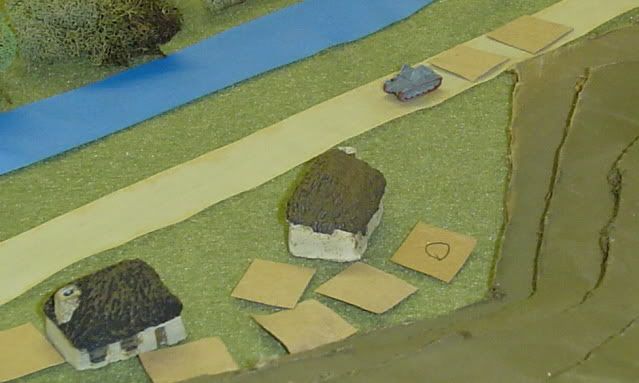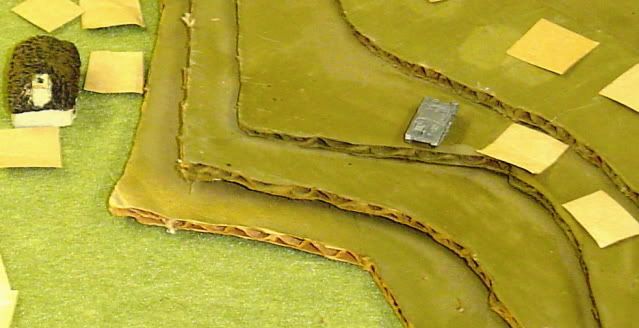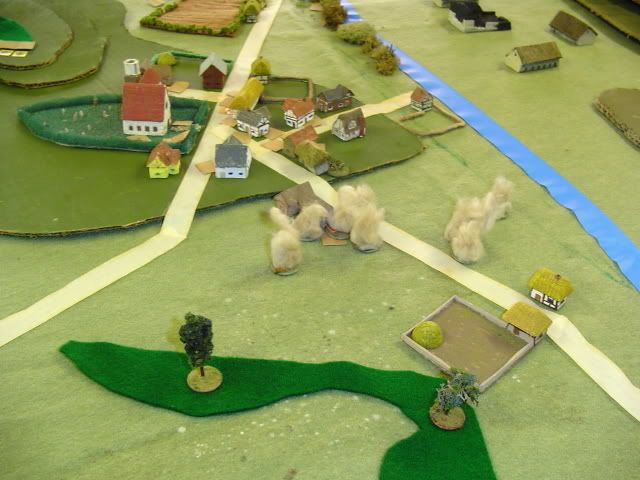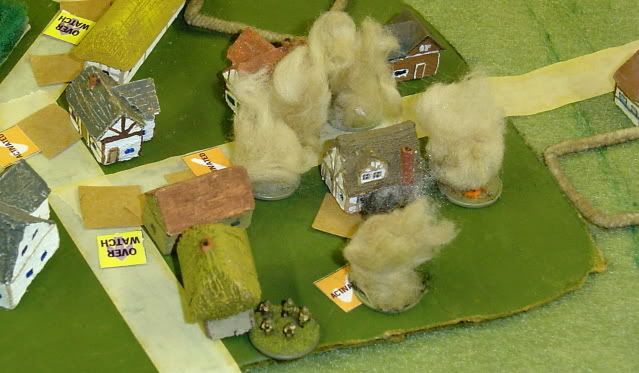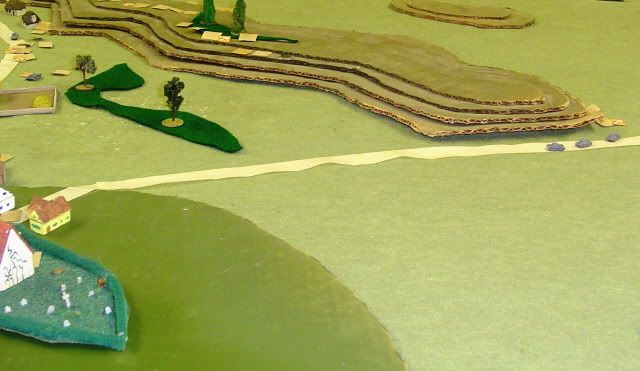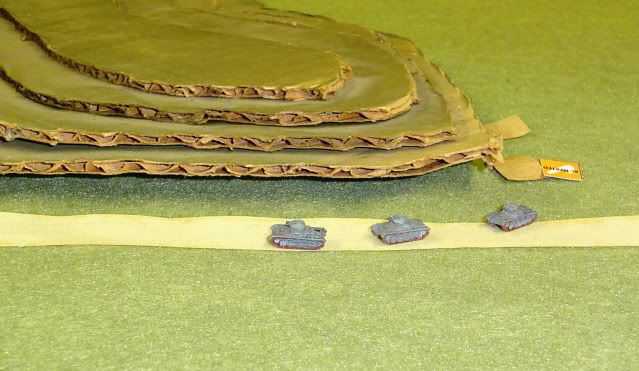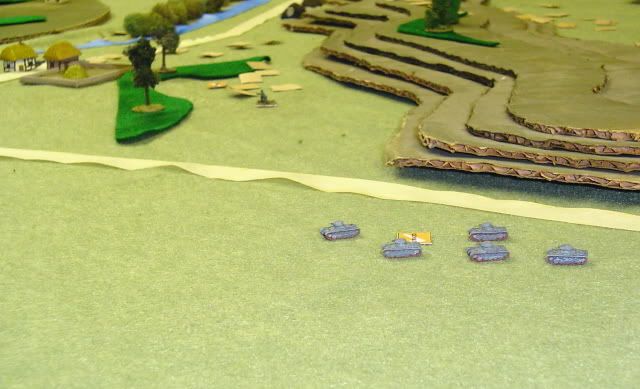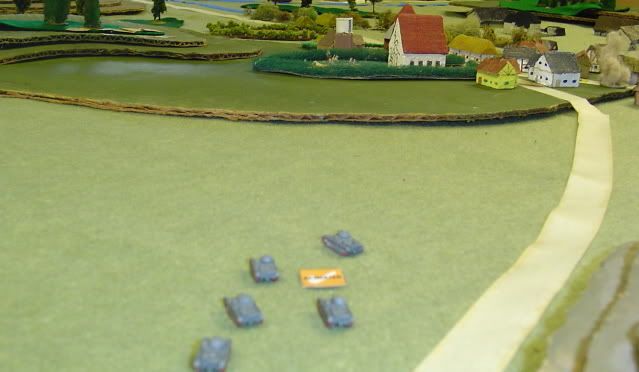
The Mk Is have oriented on to the hill that is occupied by the support platoon. This could get ugly. Markov moves his one AT rifle into the hedge on the south side of the church graveyard, but that gun, for all its promise, is a short-ranged weapon. The Mk 1s may very well overrun the support platoon without ever passing within 300m of the church yard.
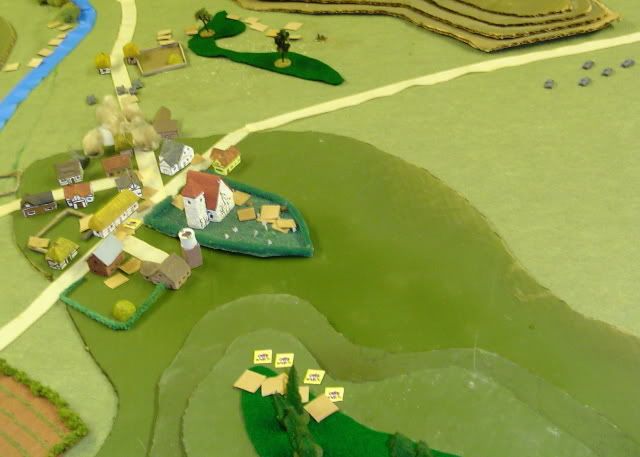
Artillery rounds continue to fall, now not only mortars but 75mm cannon rounds as well. But there is no one in the eastern edge of the village, so all the noise and dust only serves to keep the two sides apart for the moment.Still, behind their barrage, the Germans are advancing. The StuGs and PzJaegers move forward carefully, while the infantry advances making use of the available cover.The Pz Is continue their bold charge. But now there seems to be some activity in the graveyard behind the church. It seems some new units are approaching the eastern hedge.A cannon shot rings out. Then another. The clang of shot striking armor. Unbelievably, a 45mm AP round bounces off of a Mk 1's armor! :o
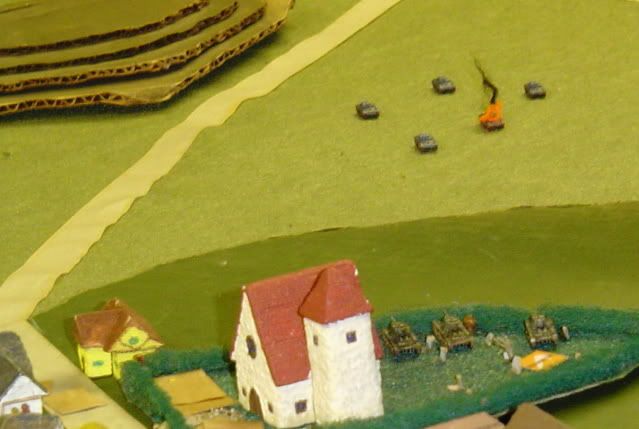
But the second hit does not bounce. B) The T-26s have arrived, and now set about the work of shooting up Pz Is.
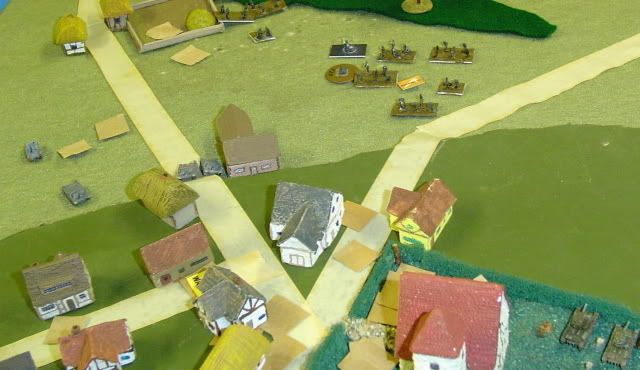
At the same time, the German infantry breaks cover, and begins their advance on the village. The StuGs move forward in support.The T-26s may have a field-day with the Pz Is, but are they facing the real threat? Markov bets that his few precious tanks can finish off the pesky light panzers before they are needed in the fight against the main attack.
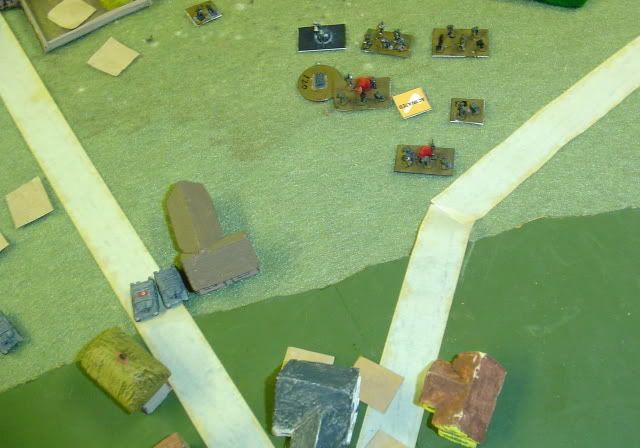
The Soviet infantry opens fire on the advancing landsers. To the Germans' dismay, they can not spot where the fire is coming from, and take casualties without the ability to reply.
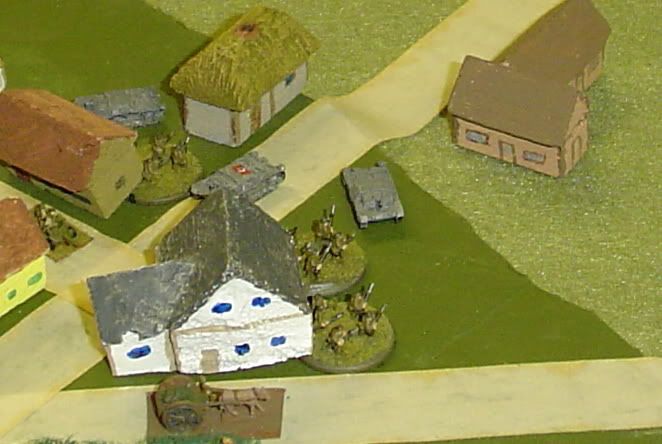
But the landsers are not alone. The StuGs advance boldly into contact with the Soviet infantry. At this range, even infantry in cover is visible!The German CO is surprised when a Soviet rifle squad fires on an advancing StuG. He expresses some dismay when he learns that even small arms have an offensive value against armor. But when he sees the adjudication in detail, he observes that the small arms fire can do no worse than suppress his AFV, and even that is a long-shot. So the fire takes place, and the StuGs keep rolling.Then a rifle squad charges a StuG to engage it in a close-assault. As he has come within 2 inches, the StuG gets a bonus "reaction fire". But without a traversable turret, and with no self-defense MG, there is no shot for the StuG to take! The infantry assaults, suppresses the StuG, and makes a clean get-away (1 inch bonus move). It is becoming clear that along village streets, determined infantry can be a real threat to a StuG.At this time, a mystery chit was revealed. This chit had been advancing slowly up the west road since the very first turn. The German commander had suspected heavy Soviet armor in the area, and facing an unknown unit moving with such deliberation had confirmed in his mind that he would face a KV once he got in to town. He was deploying his few cannon-armed AFVs to counter just such an eventuality.In the end, the mystery chit was revealed to be an old Lithuanian farmer, his horse as deaf as he, who was so sick of Russians running around in his homeland that he was determined to ignore them and go about his business in his farm cart as if they were not even there. What he would have thought of the Germans after the next turn or two, was not to be found in this game.
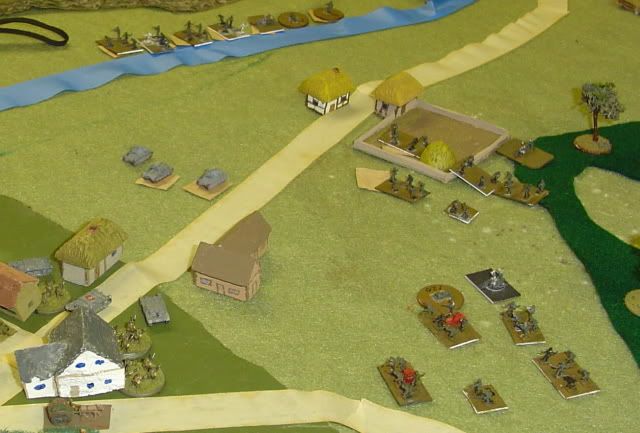
Unfortunately, that's were our game had to end.The Germans were advancing, but not without difficulty. The StuGs were at risk, the PzJaegers would be in worse trouble if they waded in to the village, and it was not clear if the landsers would be able to advance across the open fields to gain the streets of the village. The Pz Is were a lost cause, it being only a matter of whether they would die slowly enough to keep the T-26s busy for long. The third German platoon was advancing on the north shore of the stream, and might have been able to make an impact within 3 or 4 more turns.
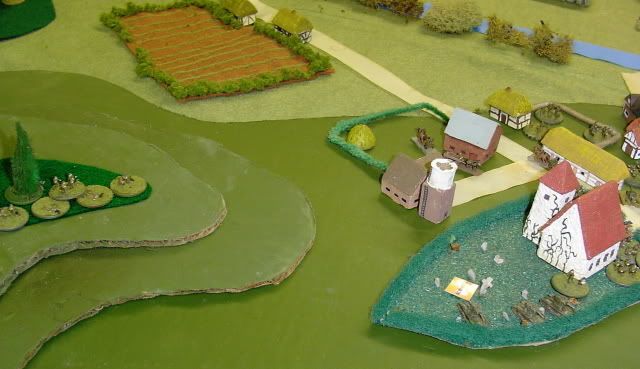
The Russian 2nd platoon had successfully pulled back out of the barrage with no casualties, and was emplaced at the walled farm on the northwest side of the village. From here they may well have been able to defend against the German third platoon.
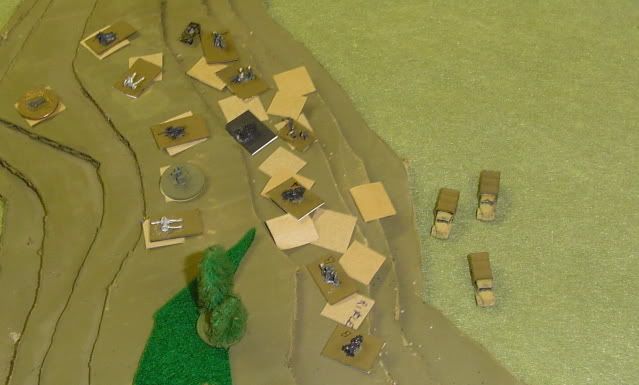
The Germans also had some significant forces along the eastern ridge. Besides the mortars and 75mm IGs, they also had some Pak36 AT guns. But the range was too great for them to influence the battle in the village.And so our battle had to end with no decision. A few more turns could have tipped the balance either way.We didn't get to play for as long as I normally do. We started about 1:30pm, and finished about 6:00pm. We took several breaks in the process. The beer was good. We looked over some of my modeling tools and discussed the tricks of the trade with micro-armor. (James is still new to the field.) I would say we got about 3 to 3 1/2 hours of actual gaming in. We got as far as we did in about 3 1/2 hours, with one player who had never seen the Mein Panzer rules before. I think that's not too bad. The game was moving pretty smoothly after the first two or three turns. I enjoyed it greatly.For me, the key issue was seeing if the new squad-based rules make real combined arms gaming possible on a 1-to-1 unit scale. I believe they do. After one or two more games, I believe I'll be able to field a battalion sized task-force, on a table with several other battalions, and play a game to resolution in 5 or 6 hours. That's what I'm looking for. I think I've found my ruleset.-Mark 1




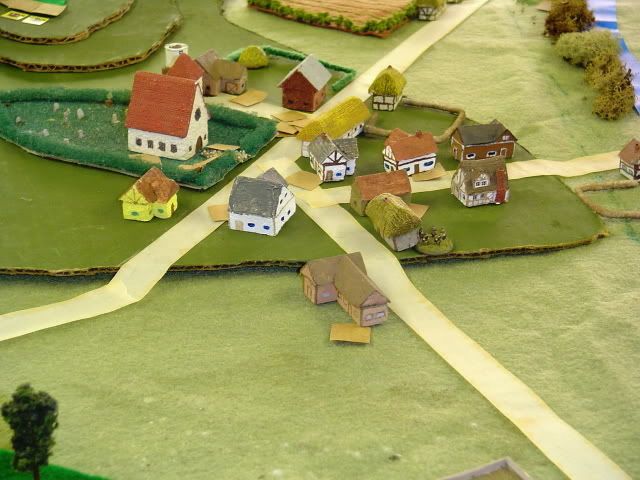
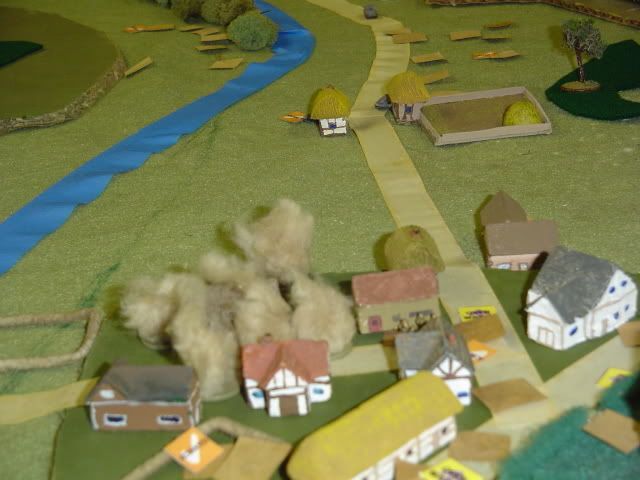
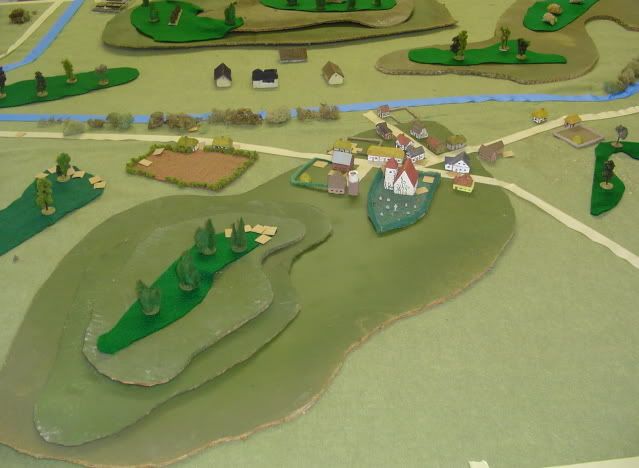 We are looking at the village from the south towards the north. It seems to Markov that the most likely avenue of advance for the Germans would be along the road which comes in from the west. (We used a die roll, done in secret, with modifiers which favored the west, to determine James' actual point of entry.) There is a small bridge over the stream, out of view in this picture about 3 Km to the west. As we are in high-summer stream is fordable at most points, although it may slow down vehicles somewhat.Markov has placed his HQ in the village church, with the company transport wagon in the entry yard, and one squad of men and the AT rifle in the hedge around the graveyard. His command staff is in the steeple looking west, where they can use flags to communicate with subordinate platoon leaders.The support platoon, with one squad of rifles, two 50mm mortars, and two Maxim MGs attached, are in the edge of the woods on the top of the small hill to the southwest. From here they can bring their longer-ranged firepower on to any force that tries to flank the troops in the village proper. The AT guns, with one command rifle squad and one LMG in support, are deployed on either side of the road facing west, behind a hedge and a farm wall. The first platoon of infantry backs them up in the village around the crossroad, while the second platoon is guarding the eastern and southern approaches to the town. The third platoon is deployed with the tanks along the edge of a small copse of woods to the west of the village, south of the road, where they should have a field day against anyone coming in on the road itself. False positions have been created (blank chits placed) along the edge of the crop fields of the small collective farm west of town, and in the trees along the stream to its north.
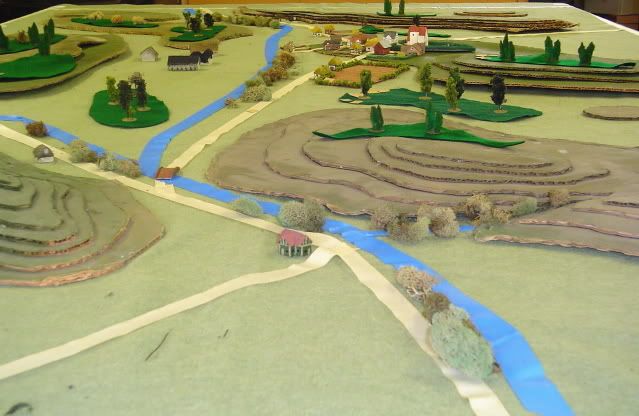 This is the view from the west. This is the direction the Germans are expected to come from. Although Markov would like to defend the bridge and/or the larger hills to the west, he feels he does not have the firepower nor the mobility to spread his forces out over such a large area.
 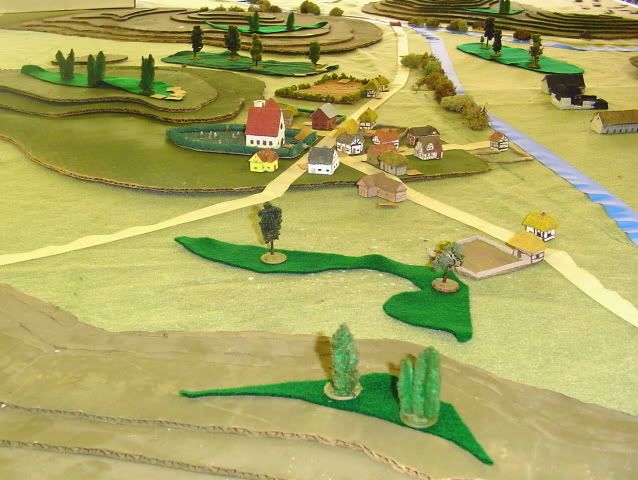 At least on the issue of not seperating his command it looks like he makes the right call. This view is from the east. This is the direction the Germans will actually come from!
 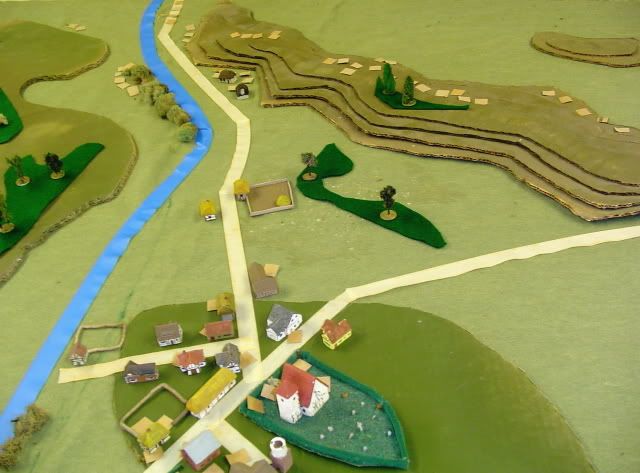 As morning breaks, the sounds of an approaching army are heard from the east. Markov's little command is in trouble.... more ...